CRO Audit
Uncover the friction costing conversions and leave with a prioritised opportunity roadmap.
ExploreAs a conversion optimisation agency, we turn customer evidence into clearer buying journeys, better experiments and more value from existing traffic.
Specialist CRO expertise. Powered by GIM.
Research. Experimentation. Commercial measurement.
Get a focused review of your page, on desktop and mobile. See the friction to investigate, the changes to consider and where to start.
Publicly accessible pages. Findings are recommendations to evaluate, not measured revenue losses.
Illustrative examples. Your audit uses screenshots of the page you submit.
Submit the page where a purchase, enquiry or sign-up matters most.
Add your work email, review the scope and place your order. We email your invoice with a secure payment link.
Within 2 working days of payment, receive the findings, supporting screenshots and a clear order of priority.
One-off service · €300 excl. VAT · Delivered within 2 working days of payment.
This is the real report from 16 November 2026: 4 findings on 98cro.com/book-consultation/, each pinned to the screenshot it came from, in the order we would work on them.
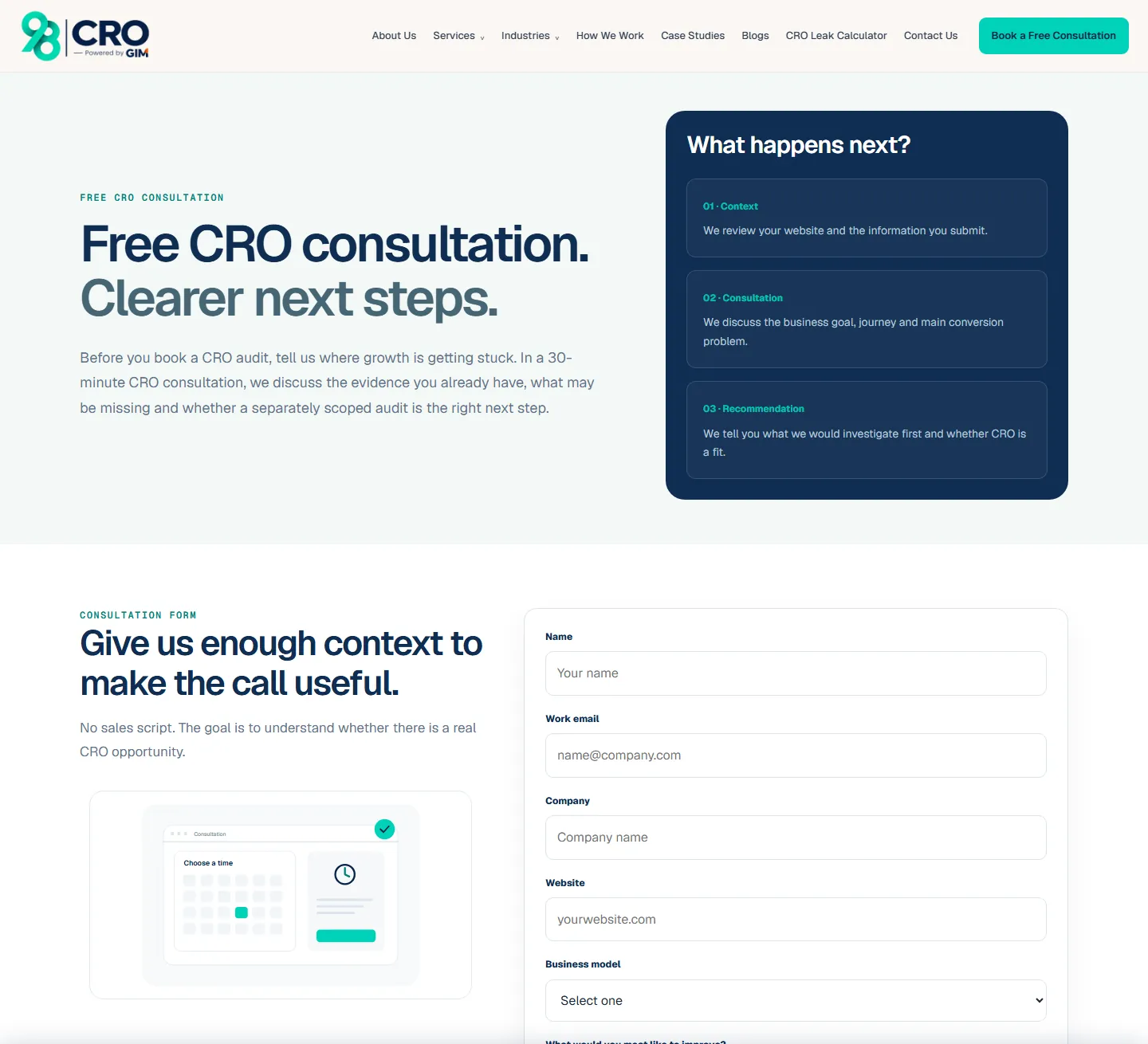
The consultation form has seven fields, and six of them are required: name, work email, company, website, business model and what to improve. Only "Anything else we should know?" is optional.
Keep name, work email and website required. Make company, business model and the improvement goal optional, or ask them in the confirmation email. Label the optional fields clearly.
The page is called "Book a Free Consultation" and the illustration shows a calendar labelled "Choose a time", but the form ends with "Request Consultation" and the page does not say when or how a time is agreed.
Either show a booking calendar after the form is sent, or state the response time next to the button, for example "We reply within one working day with suggested times".
There is no name, photo or credential near the form. The people behind 98CRO appear only on the About page.
Add a short block beside the form with the consultant's photo, name and role, and one line of genuine background such as the agency's years in business.
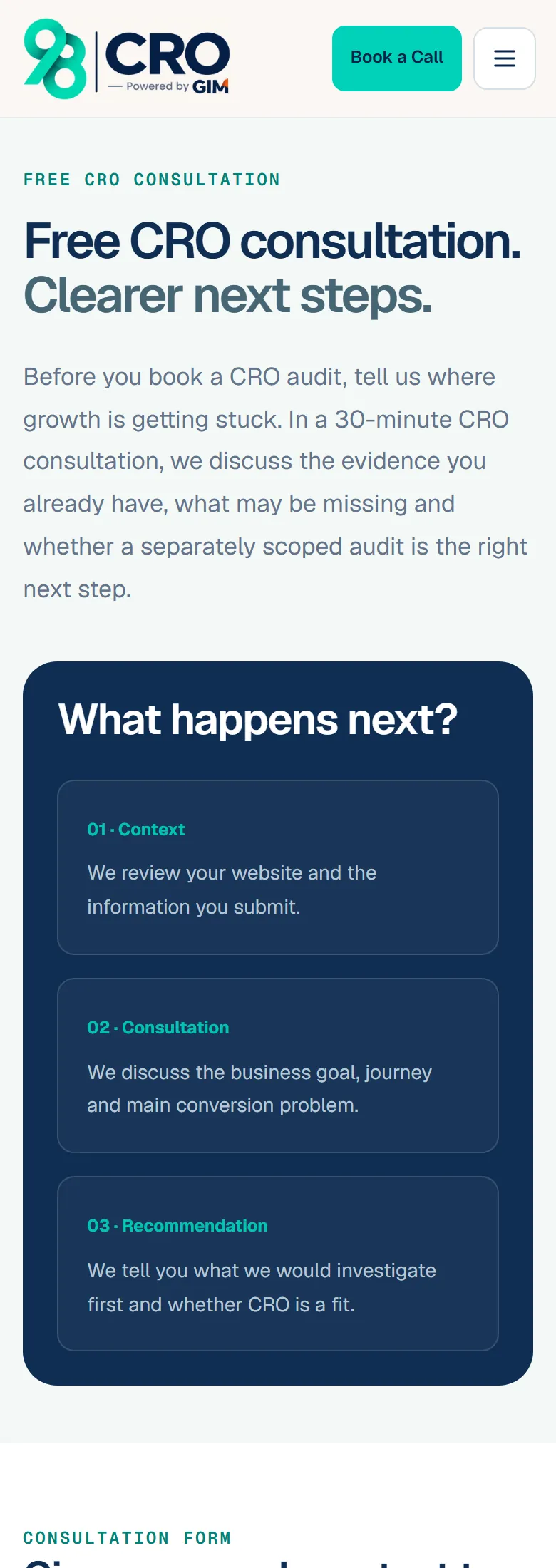
On a phone the first screen shows the headline, the introduction and the start of the "What happens next" card. The form starts about two screens further down, and there is no button that leads to it.
Add a "Go to the form" button under the introduction on mobile, or place the form before the "What happens next" card on small screens.
Findings shown as written in the report. The full PDF also explains the likely friction and how to evaluate each change. Screenshots from 16 November 2026. We have since made the four changes on the live page, so it now looks different.
Start with diagnosis, ongoing optimisation, research, experimentation or targeted support, depending on where the bottleneck is.
Uncover the friction costing conversions and leave with a prioritised opportunity roadmap.
ExploreBuild an ongoing cycle of research, hypotheses, experiments, learning and optimisation.
ExploreUnderstand what users need, what they misunderstand and what stops them taking action.
ExploreValidate ideas with controlled experiments and turn every result into reusable knowledge.
ExploreImprove message clarity, relevance, trust, friction and conversion paths on high-value pages.
ExploreStrengthen your internal CRO capability with strategy, prioritisation and experimentation guidance.
ExploreIf acquisition keeps growing but sales, leads or bookings don’t move with it, the leak is often inside the journey you already own.
Most conversion problems are not one dramatic flaw. They are small moments of uncertainty, friction or weak motivation that compound across the journey.
We connect what users do with what the business needs. That means prioritising evidence, expected commercial impact, confidence and implementation effort before deciding what gets changed.
The point is not to produce more audits, dashboards or redesigns. The point is to help you make better changes and know what they delivered.
Recommendations are grounded in data, behaviour and customer insight, not personal preference.
We prioritise metrics the business feels: revenue, qualified leads, bookings, activation and conversion value.
Where traffic allows, experiments reduce the risk of expensive changes based on assumptions.
If the right next step is an audit, better tracking, more traffic or no CRO yet, we’ll say so.
Before we recommend anything, we analyse your data, your users and your business model. The work then moves through one repeatable decision system.
Business goals, funnel, data, customers and current performance.
Find friction, motivation gaps and conversion opportunities.
Score opportunities by impact, confidence and effort.
Design and test the most valuable hypotheses where viable.
Analyse outcomes and capture what changed user behaviour.
Implement winners and feed insight into the next cycle.
We apply the same evidence-led system to the metrics, journeys and economics that matter in your business model.
Turn more product interest into completed orders and higher value per visitor.
Improve the path from first visit to demo, trial, activation and paid customer.
Generate more qualified opportunities without treating every form fill as equal.
Reduce friction between property discovery, interest, enquiry and viewing intent.
Make direct booking journeys clearer, easier and commercially stronger.
The KPI changes with the business. We agree what success means before the work starts, then connect user behaviour to commercial outcomes.
Metrics are chosen around the journey and economics of the client, not copied from a generic CRO dashboard.
Every opportunity should be able to answer four questions.
How to tell the difference between an acquisition problem and a conversion problem before increasing spend.
Read articleA good consultation should help you decide whether to optimise now, fix foundations first or invest somewhere else.
Clear answers to the questions that should be discussed before any optimisation programme begins.
When comparing CRO agencies, ask how they investigate customer behaviour, prioritise opportunities and measure results. A CRO agency should be able to explain the evidence behind a recommendation and the business outcome it is intended to improve.
Tell us your location, time zone and implementation setup. We can discuss remote collaboration, agree responsibilities and confirm availability before scoping a project.
We identify where and why users fail to convert, prioritise the highest-value opportunities, test or validate better experiences and measure the result against business KPIs.
Yes, controlled testing needs enough volume and conversions to produce useful evidence. If traffic is too low, we can use research, analytics, usability work and other validation methods instead of forcing an A/B test.
Yes. 98CRO can work as a specialist layer alongside internal teams, developers or other agencies. The aim is to make better conversion decisions without disrupting ownership of the wider stack.
No. Some businesses need a focused CRO Audit, research project or landing page programme. Others are ready for Continuous CRO. We recommend the engagement model after understanding the opportunity.
We define success around the commercial model: revenue per visitor, purchases, qualified leads, demos, activation, booking completion or another agreed KPI. Conversion rate alone is rarely enough context.
We will tell you. The right next step may be fixing tracking, generating more demand, improving the offer or waiting until the business has enough volume to optimise reliably.
Book a 30-minute consultation. We’ll look at your current situation and tell you what we believe the most sensible next step is.